

INCREASING HUMANITARIAN NEEDS
By mid-June, NOAA’s Climate Prediction Center has confirmed El Niño conditions, which are expected to persist until February-March 2027. Forecasts suggest a strong to very strong El Niño event, with peak intensity potentially ranking among the highest recorded since 1950.
El Niño-induced temperature and precipitation anomalies are expected from Mid-2026 to the first quarter of 2027 in southern Africa (dry conditions), Asia and the Pacific (dry conditions), the Caribbean (dry conditions), Central and South America (dry/wet conditions), Central Asia (dry/wet conditions conditions), Southwest Asia (dry conditions) and East Africa (wet conditions).
Countries at risk
Climate change has the potential to amplify El Niño-induced rainfall and temperature anomalies, triggering unpredictable and potentially more extreme outcomes.
What does ENSO stand for?
ENSO stands for El Niño–Southern Oscillation, a periodic fluctuation in sea surface temperatures and in the air pressure across the equatorial Pacific Ocean.
ENSO is one of the main drivers of interannual climate variability. The two extreme ENSO phases are El Niño and La Niña. El Niño occurs when the surface waters in the central and eastern Pacific Ocean become warmer than average, while La Niña occurs when these waters become cooler than average.
These changes in sea surface temperatures can cause shifts in atmospheric pressure and winds, leading to changes in rainfall patterns, temperature, and other weather-related phenomena worldwide.
Although the ENSO cycle is independent of climate change, climate change can amplify the rainfall variability related to ENSO and increase the likelihood of extreme weather events. Global warming is also increasing ENSO variability, and strong El Niño and La Niña events have occurred more frequently than the pre-1960 average. More frequent swings from a strong El Niño to a strong La Niña are anticipated in the future.
Click on this interactive diagram to explore the rainfall and temperature anomalies, the associated hazards, and the main humanitarian impact dimensions of La Niña.
GLOBAL HUMANITARIAN IMPACTS OF EL NIÑ0
How does ACAPS assess the risk of El Niño impact?
The assigned risk level to the impacts of El Niño is based on expert judgement following an assessment per country of the indicators and factors listed as follows:
historical impact of previous El Niño events in the country
typical influence of El Niño between July–December in the country
seasonal precipitation and temperature forecasts
pre-existing humanitarian crises and vulnerabilities to El Niño-induced hazards
agricultural seasonality
national and local response capacity to natural hazards and their impact
expected impact on agriculture, livestock, and fishery
potential spillover effects of El Niño on local food prices and the economy
potential disease outbreaks and increased health needs.
Analysis products
on
EL NIÑO: COUNTRIES TO WATCH

05 February 2026
West Asia: La Niña and water crisis - anticipated risks in 2026
DOCUMENT / PDF / 1 MB
This report provides an overview of the anticipated humanitarian risks triggered by drought in 2026 across West Asia, aiming to support emergency preparedness and response.
21 November 2025
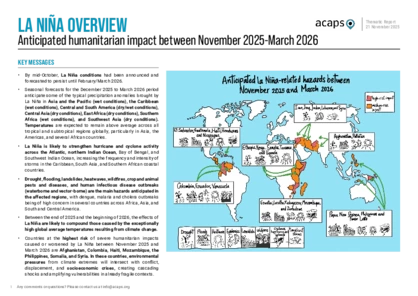
La Niña Overview - anticipated humanitarian impact between November 2025-March 2026
DOCUMENT / PDF / 600 KB
This report provides a global overview of the anticipated humanitarian impact of La Niña between November 2025 and March 2026, aiming to support strategic planning and anticipatory action in the humanitarian sector.

22 April 2025
Myanmar: Exposure to seasonal hazards in earthquake-affected areas
DOCUMENT / PDF / 421 KB
Myanmar has recently been struck by a magnitude-7.7 earthquake and is approaching the start of its monsoon and cyclone seasons, with forecasts predicting above-average rainfall and temperatures. These challenging conditions, coupled with conflict, poverty, and diminished coping capacities, may present significant risks to the population.
13 November 2024
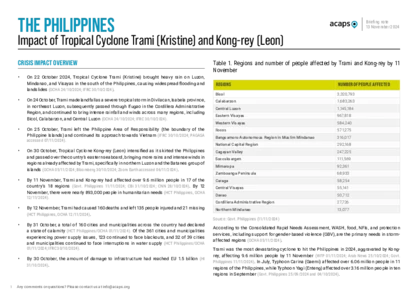
The Philippines: Impact of Tropical Cyclone Trami (Kristine) and Kong-rey (Leon)
DOCUMENT / PDF / 481 KB
By 11 November, Trami and Kong-rey had affected over 9.6 million people in 17 of the country’s 18 regions. By 12 November, there were nearly 893,000 people in humanitarian needs. By 31 October, a total of 160 cities and municipalities across the country had declared a state of calamity.
31 October 2024
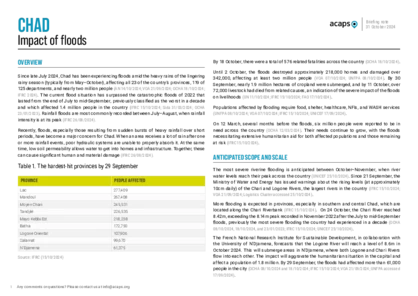
Chad: Impact of floods
DOCUMENT / PDF / 302 KB
Since late July 2024, Chad has been experiencing floods amid the heavy rains of the lingering rainy season (typically from May–October), affecting all 23 of the country’s provinces, 119 of 125 departments, and nearly two million people.